J J Cahill Memorial High School (JJCMHS), located in Sydney’s Eastern Suburbs, is an inclusive public school that takes an innovative approach to student health and wellbeing. Under the leadership of Principal Ralph David, the school emphasises environmental stewardship and strong community relationships as key elements in creating a supportive environment for students.
“I don’t want to be the principal of a school that ends at the school gate. I want to support greater connections with the community”, Ralph said.
In 2023, Ralph and J J Cahill’s Parents & Citizens (P&C) President, Daniel Girling-Butcher, recognised an opportunity to enhance community wellbeing and the school’s environment by reintroducing native vegetation to the school campus. Partnering with the University of Technology Sydney (UTS), the ‘Landscapes for Well-Being’ project was launched.
Named after Landscape Architect Tanya Wood’s UTS Design Studio course, the project’s first phase saw the installation of over 1,000 endangered Eastern Suburbs Banksia plants in December 2023. Now, with a second installation complete and preparations underway for future phases, Ralph celebrates the project’s many positive outcomes—evident in the flourishing garden and a rise in Year 7 enrolments.
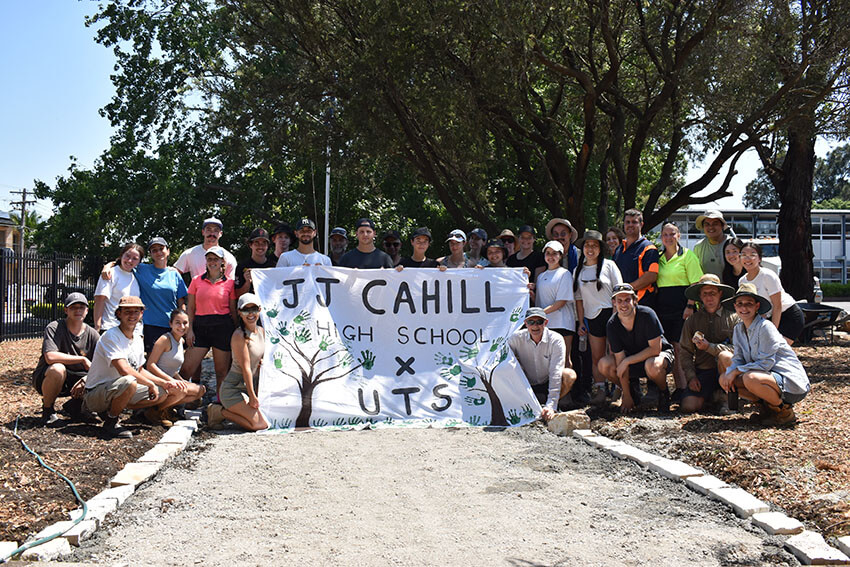
To kick off the project, the UTS Landscape Architecture and Architecture students conducted a site analysis and collaborated with school leadership to identify an area of the campus best suited for enhancement. Tanya recalls her students noticing that “on hot days, school children instinctively moved away from the heat-retaining asphalt toward the cooler zones where the green canopy helped mitigate the heat”. Coupled with consultations with JJCMHS students, this observation sparked the idea to enhance the garden space—an accessible area sandwiched between both a heat-absorbing car park and a road.
A key challenge for the garden site was balancing ecological regeneration with access to shade. While removing exotic canopy trees aligned with native restoration goals, the UTS students chose to retain them – recognising the vital shade they will provide while the young Banksias mature.
“Shade is so critical, especially in the school setting. The importance of having a canopy outweighs whether the trees are native”, Tanya said.
The UTS Landscape Architecture and Architecture students presented this proposal to a panel comprising school leaders, P&C members, JJCMHS students, and external experts. Following its approval, the garden enhancements were brought to life through a collaborative installation involving UTS students, school students, staff, parents, public officials, and local community members. As part of the process, JJCMHS students had the opportunity to visit a local Indigenous nursery, where the plants for the garden were sourced—deepening their understanding of native species.

The regeneration of the Eastern Suburbs Banksias has transformed the garden into a vibrant space for learning and enjoyment. Students now engage with the garden as part of school sport, led by a science teacher and a staff member with expertise in native plants. Some science lessons are already being conducted in the garden, offering hands-on learning opportunities. Formal integration of the garden into the coursework is in development to support environmental and sustainability education, including a proposed agriculture elective focused on native plants.
Beyond its educational role, the garden has become a valued space for wellbeing and community connection. The garden is a great place for “brain breaks” and is seen as a safe and supportive space for neurodiverse students and those with mental health needs. On weekends, the garden is enjoyed by recreational programs and church groups through the Department of Education’s Share Our Space initiative, extending its benefits to the broader community.
The project has garnered significant interest, earning several awards, including the Australian Institute of Landscape Architects 2024 National Award of Excellence for Community Contribution and the 2024 NSW ShadeSmart Award. Cancer Council NSW is a proud partner in the ShadeSmart program, working with the Australian Institute of Landscape Architects and the Cancer Institute NSW to support quality shade design and UV protection in the built environment. The project’s success was further highlighted when Ralph and Daniel were invited to speak at the P&C Federation Annual Conference, showcasing the project as an example of successful community collaboration.
Ralph believes that this project would not have been possible without the visionary guidance and assistance of J J Cahill’s P&C in securing the necessary funds. Echoing this sentiment, Tanya encourages other schools aiming to implement similar projects to collaborate with their local community. Tanya highlighted, “the involvement of tertiary students, local nurseries, and support of local councillors is key”.

Following the project’s success, Ralph became interested in further expanding and regenerating natural spaces at J J Cahill. This led to continued participation in the Landscapes for Well-Being project. In December 2024, the second installation took place, with a further 1,000 Eastern Suburbs Banksia Scrub plants added to the garden site.
The Importance of Shade in Schools
As places where children and adolescents – who are particularly vulnerable to harmful UV radiation – spend significant time, schools are well-placed to promote sun safety. One of the most effective ways to reduce UV exposure in schools is by providing quality shade.
Quality shade can reduce UV exposure by up to 75%, offering consistent protection without depending on individual choices, such as wearing sunscreen. Shade also helps reduce heat, improve health, promote outdoor activities, and enhance biodiversity. By prioritising shade, schools can create healthier, safer, and more vibrant environments that support student and staff wellbeing.
Supporting Schools to Take Action
Cancer Council NSW is proud to support schools like J J Cahill in their commitment to sun safety. Through our SunSmart program, we work with schools and early childhood education and care services to create sun safe environments and promote lifelong sun protection behaviours.
Schools seeking to provide more effective shade are encouraged to explore our Shade Advocacy Toolkit—a practical guide designed to help assess existing shade, identify opportunities for improvement, and advocate for additional shade.
Join us in creating healthier spaces for young Australians. Preventing skin cancer takes all of us.
Do you have a sun safety story to share? We’d love to hear how your childcare service or school is promoting sun safety. Whether it’s a creative idea or successful initiative — share your story with us at [email protected].